
2025 MINERAL RESOURCE ESTIMATE
PHASE 1 TOLL MILLING FEASIBILITY STUDY
Phase 1 of the Life of Mine ("LOM") will utilise underground mining and toll-milling of the high-grade Champagne Zone. During Phase 1 production, efforts will be directed for assessing and developing Phase 2, which plans to further develop both underground and open pit operating areas.
Phase 2 will also contemplate the construction of an on-site mill and additional facilities to facilitate processing of the remaining mineralization (please refer to the Company's 2.3 million ounce resource reported on May 21, 2025).
In parallel, AMEX will continue exploration activities on the newly expanded land package. That covers some 70 kilometers of strike with a consolidated land package spanning a district-scale 618.53 km². This extensive property lies within highly prospective, geology favourable areas for both high-grade gold and VMS mineralization that in all likelihood will
Phase 1 Toll Milling Feasibility Study Summary:
The Perron FS incorporates the latest Mineral Resource Estimate (MRE - released May 21st, 2025stMRE - released May 21st, 2025). The following assumes a gold price of USD$3,500/ounce ("oz") and a CAD$/USD$ exchange rate of 1.38:1.
- Phase 1 development strategy designed to unlock the full value of Perron through a disciplined and staged production approach, by leveraging existing regional infrastructure and minimizing capital intensity
- Strategy of initiating production under a toll milling arrangement to de-risk the project, simplify the permitting process, accelerate time to revenue (targeting 2028) and minimize shareholder dilution
- Phase 1 Proven and Probable reserves of 1,989 million tonnes at 12.1 grams per tonne
- 5-year 1,100 ore tonnes per day (tpd) contract mining, toll milling operation in the Abitibi region, where numerous processing plants are in operation
- Low initial capital cost estimate of $193.9M. During the pre-production period $68.1M of revenue is generated which could offset some capital required
- Average annual gold production of 147,000 oz gold ("Au") at an All in Sustaining Cost ("AISC") of US$910/oz Au
- Average diluted head grade of 12.0 grams per tonne ("gpt") for 770,000 oz Au recovered
- 0 years of commercial production
- Sustaining Capex of $238.2M
- Pre-tax NPV of $1,976M and After-tax NPV of $1,127M
- Pre-tax IRR of 160.4% and After-tax IRR of 114.6%
- Cumulative Pre-tax Undiscounted Net Free Cash Flow of $2,492M and Cumulative After-tax Undiscounted Net Free Cash Flow of $1,436M
Note: All dollar ($) amounts are in Canadian dollar ($) unless otherwise indicated.
View April 13, 2026 Press Release for more details on the Phase 1 Feasibility Study
MINERAL RESOURCE ESTIMATE
In May 2025, the Company completed an updated Mineral Resource Estimate. Consistent with the 2024 Mineral Resource Estimate, the majority of gold ounces come from the Company’s newly renamed Champagne Zone (previously named the High Grade Zone), with important contributions from the Denise, Gratien, Grey Cat and Team Zones. Geologic reinterpretation of some zones has allowed for more realistic high-grade, narrow vein potentially mineable stope shapes that are expected to have a positive impact on an updated PEA to be released later this year. All zones on the Property remain open for further expansion.
- Mineral Resource Estimate: All constrained Zones contain 1.615 Moz Measured & Indicated Resources at 6.14 g/t Au and an Inferred Resource of 698 koz at 4.31 g/t Au
- Champagne Zone contains resources of 831 koz of Measured and Indicated Mineral Resources at a grade of 16.20 g/t Au and 128 koz of Inferred at a grade of 9.83 g/t Au
- 172% increase in Measured & Indicated Resources over the 2024 Mineral Resource Estimate, with a 43% increase in grade realized.
- Estimates based on high-grade, selective narrow vein mining operation approach
- Additional Mineral Resource potential: to expand the deposits in all directions for future Mineral Resource estimation. With a land package increase from 45.6 to 197.5 square kilometers (“km2”) providing additional new targets to be explored. See press release dated March 25, 2025.
- Infrastructure: The excellent nearby infrastructure continues to play a vital role at the Perron Project. The Company plans to complete an updated Preliminary Economic Assessment (PEA) utilizing the 2025 Mineral Resource Estimate, expected later this year.

Plan view of the mineralized wireframes for each zone of the 2025 Mineral Resource at Perron
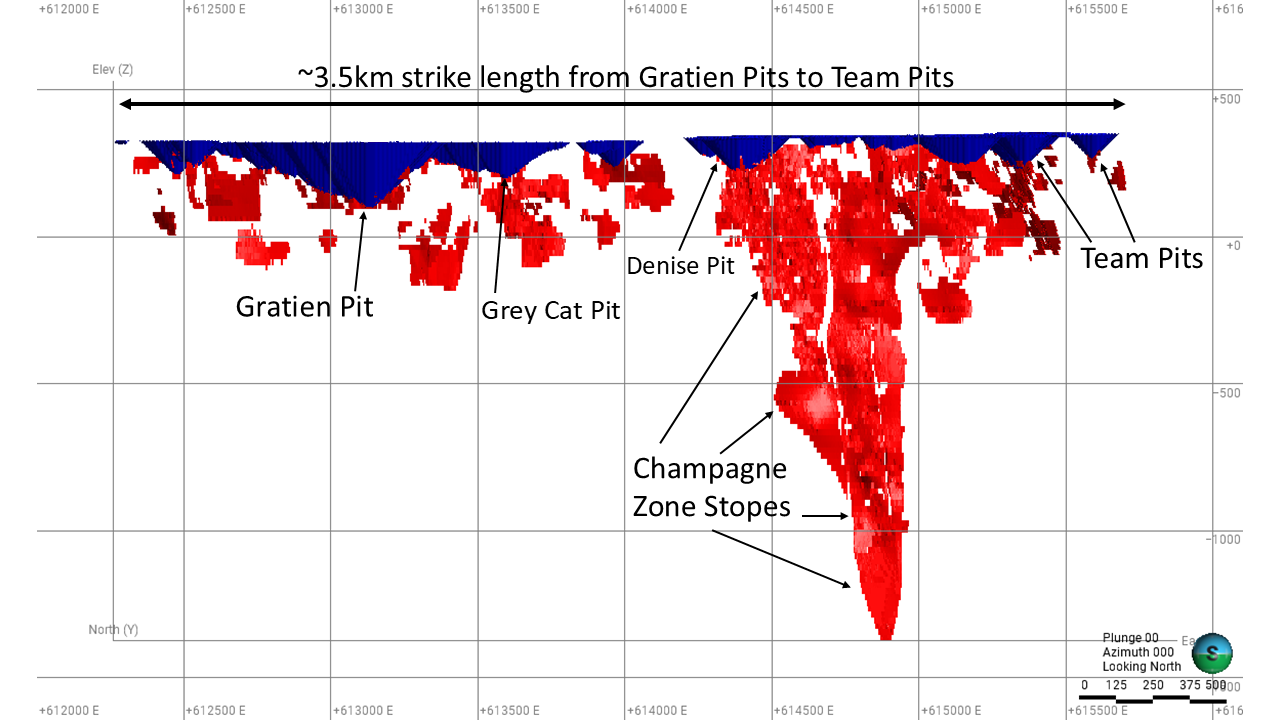
Longitudinal projection view looking to the north of the 2025 constrained Mineral Resources delineated at Perron. Open pits are shown in blue and underground stopes are displayed in red.
Independent Qualified Persons
The Mineral Resource Estimate was prepared for Amex Exploration Inc. under the supervision of P&E Mining Consultants Inc. (“P&E”). The Qualified Persons (“QP’s”) have reviewed and approved the content of this news release. Independent QP’s from P&E who have prepared and supervised the preparation of the technical information relating to this Mineral Resource Estimate are:
- Antoine Yassa, P.Geo.
- Charles Spath, M.Sc., P.Geo.
- Yungang Wu, M.Sc., P.Geo.
- Eugene Puritch, P.Eng., FEC, CET
About Perron Property
Geological Theory on Perron Project PDF
The Perron gold property is located 7 km to the Northwest of the village of Normétal, and approximately 110 km North of the town of Rouyn-Noranda in the Abitibi region of Quebec. The Perron gold property is fully road accessible year-round by government-maintained highway and forestry roads and is proximal to power and water services. In addition, the project is in close proximity to a number of major gold producers milling operations.
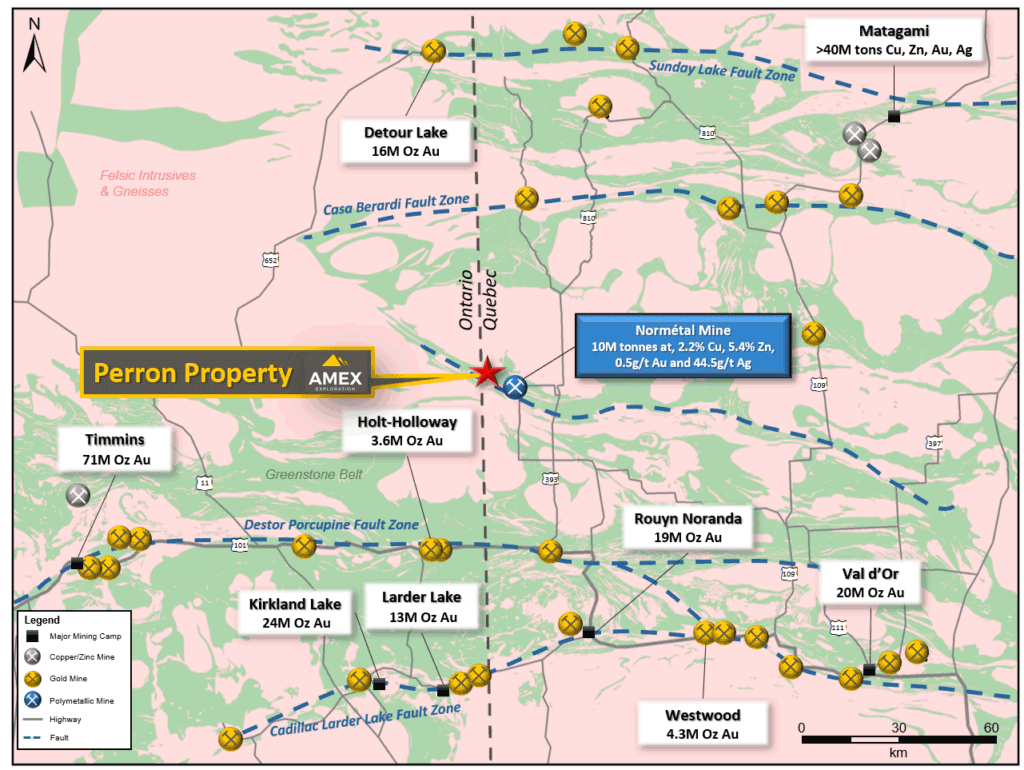
Geological map of the Western Abitibi belt with the locations of major gold and base metal mines and Perron property.
The property consists of 117 adjacent claims covering a total area of 4,560 km2 and is 100%-owned by Amex Exploration. The property is located in the Neoarchean Burntbush-Normétal volcanic belt of the Superior province. This belt includes different facies ranging from basalt through andesite to rhyolite and their subvolcanic equivalents and bounded to the south by the late Chicobi sedimentary rocks. These rocks are favourable for volcanic massive sulfides and gold development. The area is crossed by the regional NW-SE trending Normétal and Perron faults. The Normétal fault is coincident with a stratigraphic horizon known to host massive sulphide deposits such as the nearby past-producing high-grade polymetallic (Cu-Zn-Au-Ag) Normétal mine and the Zn Normetmar satellite deposit and also related to several epigenetic gold showings. The Perron fault is located about 500 to 1,000 m South of the Normétal Fault and is related to several epigenetic gold deposits and showings. These showings are hosted in sodic rhyolite of the Beaupré block including the Eastern Gold Zone followed to the west by Grey Cat Zone and Gratien Gold Zone.
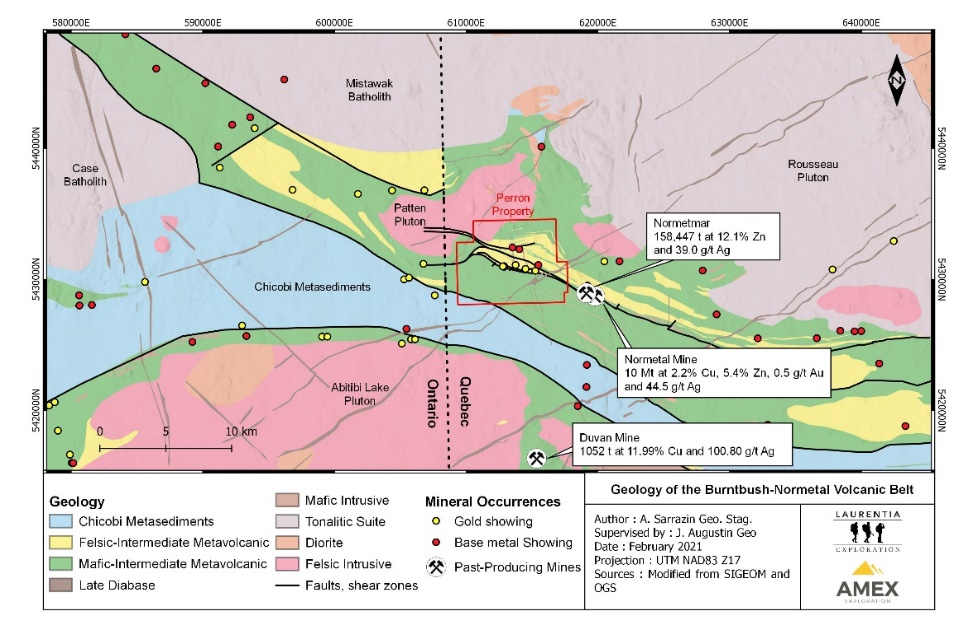 Simplified geology (SIGEOM) of the Burntbush-Normétal volcanic belt.
The Perron property was originally explored for base metals from 1994 to 1996 by Falconbridge Limited. Amex, formerly known as Minières Coleraine, was granted an option to acquire the property in 1996. The option agreement terms have long-since been fulfilled and Amex now owns 100% of the Project.
Since the acquisition of Perron, Amex has made multiple gold and base metal discoveries, namely the Eastern Gold Zone which comprises the Champagne Zone (CZ) (formerly named the High Grade Zone (HGZ)), the Denise Zone and other associated gold zones —as well as the Gratien Gold Zone, the Central Polymetallic Zone and the Grey Cat Zone. In addition several compelling regional drill results have been identified that warrant additional follow-up..
Recent regional exploration programs led to many important new discoveries: the Team Zone (including the 210 and E3 Gold Zones), Alizée Gold Zone, the E2 Gold Zone, Upper Champagne Zone, JT Gold Zone, and a new copper rich VMS discovery named the QF Zone.
 Geological map of the Perron Project, showing each of the significant mineralized zones.
Eastern Gold Zone (EGZ)
The Eastern Gold Zone was discovered in December of 2017 during a regional exploration drilling campaign. The discovery hole, PE-17-03, identified two zones of near-surface mineralization, now called the Champagne Zone and the Denise Zone, which returned values including 12.22 g/t Au over 4.66 m of core length and 0.81 g/t Au over 76.50 m of core length, respectively. Follow-up drilling in 2018 in drill hole PE-18-17 intersected values including 269.23 g/t Au over 1.35 min core length and 0.74 g/t Au over 20.75 m (core length) in the Champagne Zone and Denise Zone, respectively.
Following this, a targeted exploration drill program began in Q1 of 2019 totalling approximately 3,000 m targeting the Champagne Zone, from which assays have returned grades including 393.33 g/t over 1.70 m (core length) in PE-19-22, 39.58 g/t Au over 0.75 m (core length) in PE-19-23, and 214.71 g/t Au over 0.65 m (core length) in PE-19-24.
During the 2020-2022 drill program, Amex further defined and expanded the Denise Zone and identified exceptional high-grade gold continuity in the Champagne Zone. To date, Amex has hit very high-grade and often visible gold in multiple zones across the project forming a corridor of gold mineralization extending over 4.5 km between Eastern Denise to Western Gratien Gold Zone.
The carefully planned 2022 regional exploration program led to important new discoveries:
- the Team Zone
- the E2 Gold Zone
- the Donna Gold-Copper Zone
- the Upper Champagne Zone
- the 210 Gold Zone
 Geological map of the Eastern Gold Zone area, showing the locations of all identified zones.
The objectives for the Perron Project 2024-2025
- Complete Preliminary Economic Assessment for Q4, 2024
- Continue to expand Champagne Zone at surface and at depth
- Expand Gratien and Grey Cat Zones to west and at depth
- Continue drilling newly discovered JT Zone and complete geochronology studies on the felsic intrusion
- Search for additional felsic intrusions intruding into the Beaupré Block and follow their orientations for new discoveries
- Infill drilling between Team and old 210 and E3 zones to better define mineralization along a 1.4km strike length
- Continue hyperspectral program to define alteration packages surrounding orebodies to aid with expansion and exploration
- VMS drilling on multiple targets and expand QF Zone footprint
The 2023-2024 exploration program was multi-faceted, with an aim to advance the project beyond the exploration phase:
- Define the Team Zone from surface to ~450 vertical metres at 50 m centres
- Expand the Gratien Gold Zone to the West and to depth
- Expand on and infill the Champagne Zone and Denise zone as required
- Test the N110 Gold Corridor for Champagne Zoze-type ore shoots
- Drill to expand the VMS mineralization at the QF Zone as well as test the newly identified eastern VMS target
- Expand upon the surface geochemistry program of 2022 using the ionic leach method, which showed many promising anomalies across the project
- Continue hyperspectral program to define alteration packages surrounding orebodies to aid with expansion and exploration
- VMS drilling on multiple targets and expand QF Zone footprint
Champagne Zone (CZ)
The Champagne Zone is composed of quartz vein system hosted along the contact of a regionally extensive rhyolite package and a narrow (~1-5 m) mafic intrusion. The quartz vein(s) can occur at the upper and/or lower contact of the intrusion. Visible gold mineralization occurs most often in association with sphalerite but also as free gold within quartz or at the margins of pyrite grains. The zone strikes approximately at N265 with a dip at -85° with a slight plunge to the East at 70 to 80 degrees from vertical, in agreement with the local stretching lineation. Mineralization identified to date appears to share similarities with Archean orogenic vein-hosted gold deposits found elsewhere in the Abitibi Greenstone Belt and around the world. The zone has been intersected in the same longitudinal section over a vertical distance of approximately 1,260 m over varying spaces.
Amex demonstrated the exceptional high-grade gold continuity of Champagne Zone down to a vertical depth of 1.26 km. The Company also reported the highest-grade individual assay at Perron of 929.24 g/t Au over 0.50 m at a vertical depth of 290 m in hole PE-21-344. 2024 drill results successfully expanded the near surface mineralization of the Champagne Zone.
Highlights from 2024 drilling include:
- PE-24-788 returned 34.75 m of 2.22 g/t Au including 1.00 m of 53.16 g/t Au at a vertical depth of ~145 m
- PE-24-791 returned 10.15 m of 1.47 g/t Au including 0.75 m of 10.49 g/t Au at a vertical depth of ~260 m
Highlights from 2024 drilling of the Deeper Champagne Zone (CZ East) include:
- PE-21-318W3 returned 4.30 m of 23.81 g/t Au including 2.00 m of 50.35 g/t Au at a vertical depth of ~1,100 m
- PE-21-318W4 returned 6.55 m of 9.57 g/t Au including 1.25 m of 45.34 g/t Au at a vertical depth of ~1,150 m
- PE-21-347W5 returned 6.35 m of 30.85 g/t Au including 0.50 m of 342.10 g/t Au at a vertical depth of ~1,100 m
Highlights from 2023 drilling of the Deeper Champagne Zone (CZ East) include:
- PE-22-535 returned 75.81 g/t Au over 4.85 m at a vertical depth of ~750 m
- PE-22-524W5returned 7.40 g/t Au over 14.80 m at a vertical depth of ~1,200 m
Highlights from 2022 drilling of the Deeper Champagne Zone include:
- PE-21-404W2 returned 35.89 g/t Au over 6.75 m at a vertical depth of ~940 m
- PE-21-386W1 returned 102.07 g/t Au over 6.10 m at a vertical depth of ~870 m
- PE-21-318 returned 29.62 g/t Au over 8.40 m at a vertical depth of ~ 1,120 m
- PE-21-287 returned 37.59 g/t Au over 6.20 m at a vertical depth of ~1,070 m
- PE-21-360 returned 17.01 g/t Au over 7.40 m at a vertical depth of 500 m
- PE-21-360W1 returned 10.21 g/t Au over 7.40 m at a vertical depth of 660 m
- PE-21-165W2 returned 4.46 g/t Au over 15.60 m at a vertical depth of 660 m
- PE-21-301W1 returned 10.25 g/t Au over 6.10 m at a vertical depth of 910 m
Highlights from the 2022 drilling of the Shallower Champagne Zone (Western CZ) include:
- PE-21-366W1 returned 78.62 g/t Au over 5.90 m at a vertical depth of ~630 m
- PE-21-405 returned 43.74 g/t Au over6.80 m at a vertical depth of ~300 m
- PE-21-391 returned 84.02 g/t Au over 5.60 m at a vertical depth of ~170 m
- PE-21-409 returned 43.74 g/t Au over 6.90 m at a vertical depth of ~170 m
- PE-21-383W1 returned 76.61 g/t Au over 3.50 m at a vertical depth of ~480 m
- PE-21-392 returned 36.02 g/t Au over 6.55 m at a vertical depth of ~250 m
- PE-21-367 returned 21.75 g/t Au over 14.90 m at a vertical depth of ~190 m
- PE-21-371 returned 11.97 g/t Au over 6.95 m at a vertical depth of ~120 m
Note: the Champagne Zone drill results presented above represent core length. True width is estimated to be 55-80% of the reported core len

Longitudinal section of the Champagne Zone looking to the south, showing contoured metal factor (Au g/t * estimated true thickness). True width is estimated to be 55-80% of the reported core length.

Photos of the Champagne Zone mineralization-style (PE-19-22).
A) Quartz-carbonate shear veins of the CZ.
B) Visible gold associated with sphalerite in a CZ quartz-carbonate vein.
C) Visible gold (VG) associated with pyrite in a CZ quartz-carbonate vein.
Denise Zone (DZ)
The Denise Zone, located 50 to 100 m south and sub-parallel to the Champagne Zone, consists of disseminated and quartz vein-hosted gold mineralization hosted within a regionally extensive rhyolite package that lies north of an andesite. Gold mineralization is associated with intense sericite alteration and sulfides including pyrite & sphalerite. The Denise Zone is a bulk tonnage target. Exploration plans for 2023 was for 10,500 m of drilling aimed at both definition and expansion. A further 4,200 m was dedicated to a target to the western Denise at depth.
To date, the Company intersected at least 750 vertical metres of gold mineralization starting from surface across a strike of more than 1 kilometre. The Denise Zone surpassed expectations showing large zones of broad near-surface gold mineralization and continuity. The geology indicates probability to expand to the east near surface.
Further drilling in 2024 has expanded known mineralization of the Denise Zone at depth. Through the new interpretation of the Denise Mafic Intrusion, the Amex team continues to see growth potential for resources at depth. This also opens up the possibility of reinterpretation of the same mafic intrusion in the Champagne, meaning a potential of more area for growth of the western Champagne Zone.
Highlights from western Denise include:
- PE-21-422 intersected 1.89 g/t Au over 65.00 m, including 197.35 g/t Au over 0.50 m at a vertical of depth of ~345-390 m
- PE-21-392 intersected 1.82 g/t Au over 58.50 m, including 177.65 g/t Au over 0.50 m at a vertical of depth of ~350-400 m
- PE-20-188 intersected 1.09 g/t Au over 189.40 m, including 1.94 g/t Au over 24.50 m at a vertical of depth of ~300 m
- PE-20-54EXT intersected 2.12 g/t Au over 50.00 m, including 4.90 g/t Au over 15.10 m at a vertical of depth of ~130 m
- PE-20-181 intersected 1.39 g/t Au over 115.60 m, including 51.03 g/t Au over 2.50 m at a vertical of depth of ~260 m
Highlights from eastern Denise include:
- PE-22-510 intersected 11.57 g/t Au over 30.90 m, including 601.47 g/t Au over 0.50 m at a vertical of depth of ~510 m
- PE-22-468 intersected 0.88 g/t Au over 41.30 m, including 1.50 g/t Au over 14.90 m at a vertical of depth of ~230 m
Note: the Denise drill results presented above represent core length. True width is estimated to be 60-90% of the reported core length.
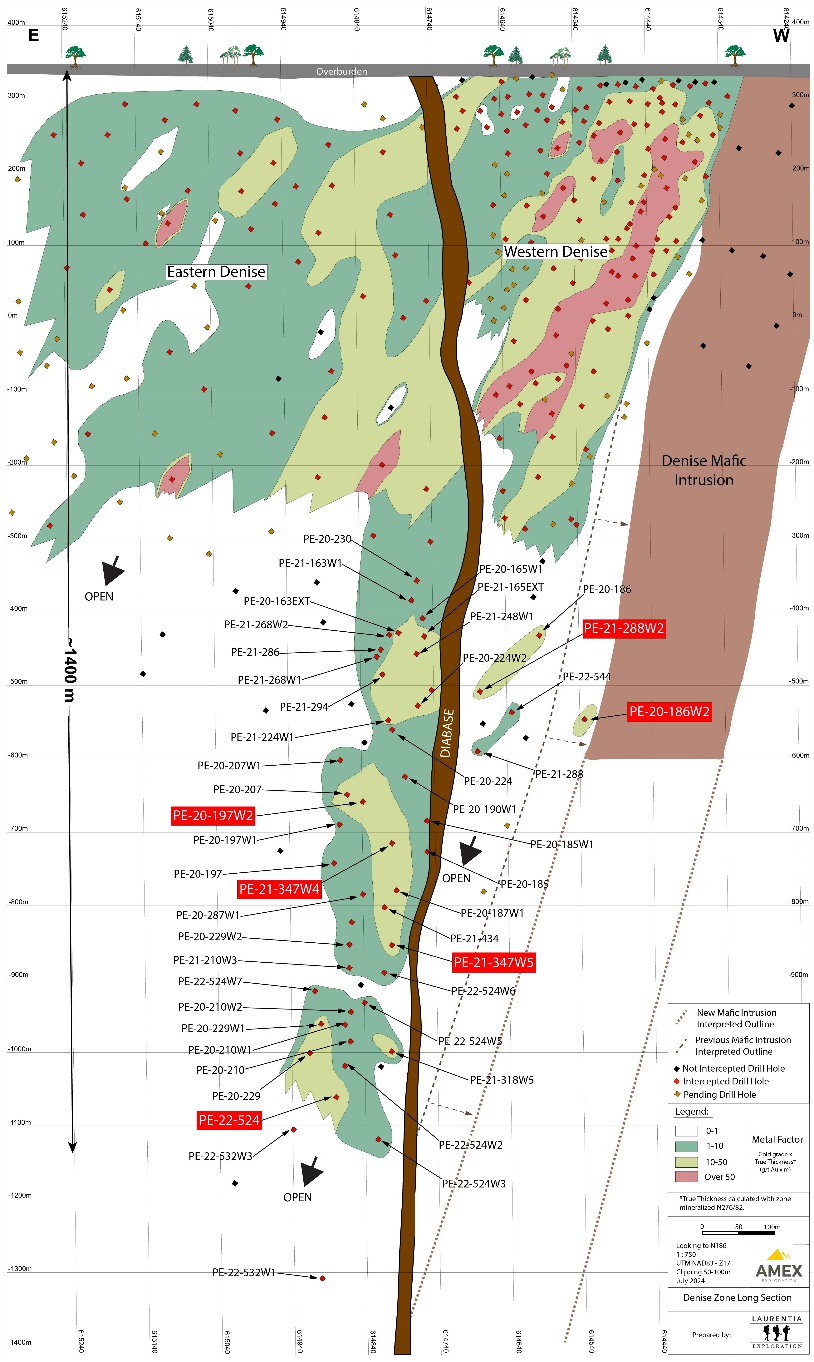 Longitudinal section of the Denise Zone looking to the south, showing contoured metal factor (Au g/t * estimated true thickness) Note drillhole PE-20-186W2 and the new interpretation of the Denise Mafic Intrusion, giving Western Denise a significantly larger area for growth potential at depth
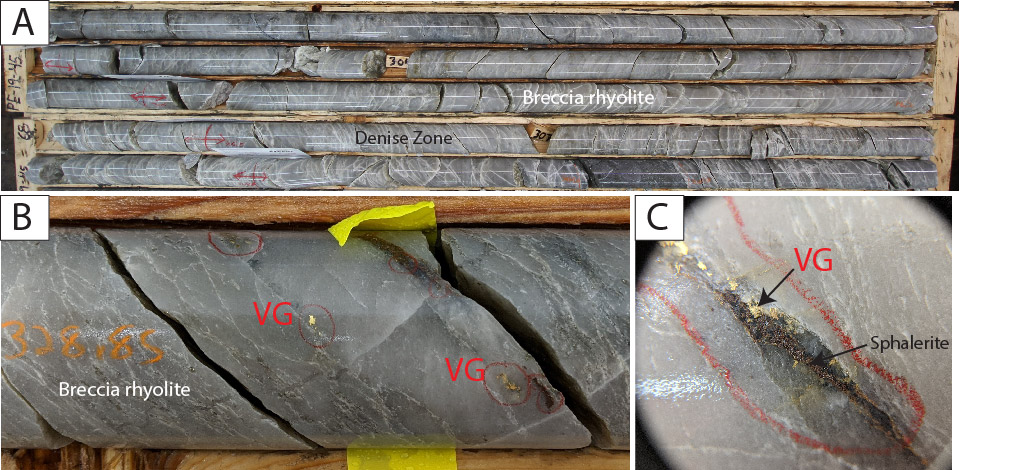
Photos of the Denise Zone mineralization-style (PE-19-45 and PE-20-192).
A) DZ defined by highly sericitised brecciated rhyolite and disseminated sulfides.
B) Visible gold (VG) in a DZ quartz-carbonate vein.
C) VG associated with sphalerite in a boudinated quartz-carbonate vein.
Gratien Gold Zone (GGZ)
The Gratien Gold Zone was discovered in the 1990s by Falconbridge. Amex Exploration (previously Coleraine Resources) optioned the property from Falconbridge in 1996. A number of very significant gold intercepts were discovered, including:
- PE1997s03 intersected 5.66 g/t Au over 8.25 m
- PE1997s04 intersected 9.76 g/t Au over 4.95 m
- PE1997s14 intersected 24.59 g/t Au over 5.50 m, including 330.79 g/t Au over 0.40 m
- PE1997s24 intersected 0.25 g/t Au over 8.00 m, including 77.68 g/t Au over 1.00 m
- PE1998s46 intersected 32.18 g/t Au over 1.60 m
- PE1999s49 intersected 35.23 g/t Au over 1.70 m
- PE1999s54 intersected 2.73 g/t Au over 18.50 m
- PE2008s03 intersected 138.65 g/t Au over 1.00 m
- PE2008s03 intersected 11.97 g/t Au over 5.10 m, including 56.13 g/t Au over 1.00 m
These historical drilling campaigns resulted in the discovery of 5 different zones of mineralization that follow the regional Perron fault horizon.
With a total strike length of 1,200 m and growing, Gratien has the potential to develop into an orebody of significant size and grade.
The best intercepts to date were on the Western Extension Gratien Zone.
- PEG-24-742 returned 3.50 m of 76.69 g/t Au, including 0.60 m of 431.72 g/t Au at a vertical depth of ~130 m in the Gratien Gold Zone;
- PEG-24-738 returned 7.30 m of 8.16 g/t Au, including 0.50 m of 98.17 g/t Au at a vertical depth of ~160 m in the Gratien Gold Zone;
The 2024 drilling has opened up Gratien for significant expansion at depth, which also remains open to the west. A new lens of mineralization was found within the rhyolite of the Upper Gratien Gold Zone, located within the Beaupré Block. The mineralization appears to be a new lens or 'stack' that make up the multiple stacked lenses of mineralization representing the Gratien Gold Zone.
The previous deepest intercepts in the western portion of Gratien were found within the andesite of the Normétal South Block. Amex believes this deep drilling has opened up a significant growth potential in the Upper Gratien Zone and appears to be on strike with the Grey Cat Zone, which is structurally compelling.
Deep Western Gratien Zone highlights:
- PEG-24-764 intersected 5.15 g/t Au over 7.40 m, including 17.32 g/t Au over 1.70 m at a vertical depth of ~325 m in the Upper Gratien Gold Zone
- PEG-24-767 intersected 20.28 g/t Au over 1.20 m, including 42.88 g/t Au over 0.55 m at a vertical depth of ~280 m in the Upper Gratien Gold Zone
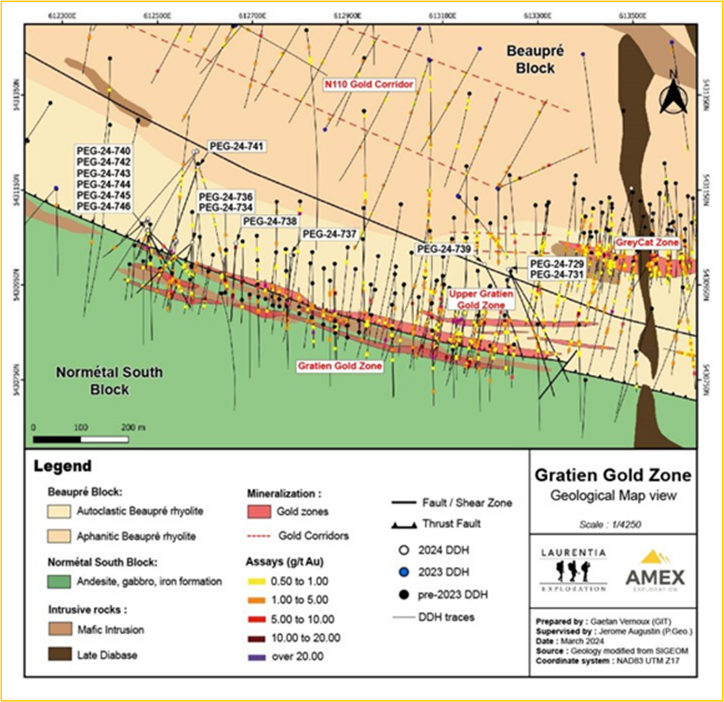 Geological map of the Gratien Gold Zone, showing gold mineralization greater than 0.50 g/t Au. Three main gold zones occur at Gratien, hosted in an autoclastic rhyolite of the Beaupré Block and in the mafic to intermediate volcanic rocks of the Normétal South Block.
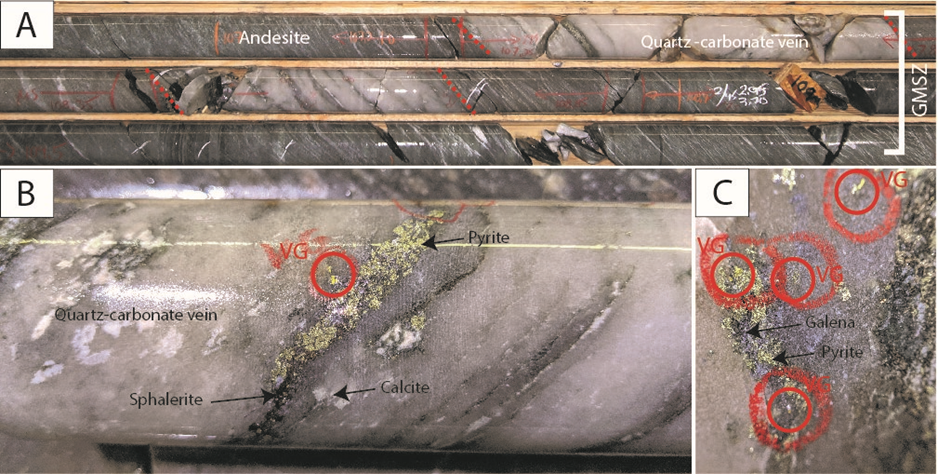 Photos of the Gratien Gold Zone (PEG-19-68).
A) Typical shear quartz-carbonate vein of GGZ.
B) Quartz-carbonate veins associated with pyrite, sphalerite and visible gold (VG) in a late.
C) Visible gold association with pyrite and galena.
Grey Cat Zone (GCZ)
The Grey Cat Zone is about 650 m from the Gratien Gold Zoneand lies in between the Eastern Gold Zone and the Gratien Gold Zone, slightly to the north of the regional Perron Fault. Grey Cat is a near-surface zone that contains high-grade gold mineralization within a broad panel of disseminated gold mineralization with intercepts of up to 26.90 m grading 3.42 g/t Au including 134.16 g/t Au over 0.50 m in hole PEG-19-80.
The Grey Cat Zone is hosted in a slightly brecciated rhyolite package and associated with a moderate sericite, silica, and chlorite alteration. Grey Cat’s Gold system is formed by a main quartz vein located along the inferior or superior contact of a mafic intrusion crosscutting the felsic units inside a larger horizon hosting several veinlets or silicified sheared zones. Visible gold is found within veins and veinlets most of the time in association with sphalerite and pyrite. Grey Cat Zone gold mineralization differs from previously announced gold mineralization at the Champagne Zone and the Gratien Gold Zone in that the gold is more widespread through broader panels of the host rock rather than concentrated in individual veins.
However, the Grey Cat Zone shares the characteristic of having a rich vein along the contact of a mafic intrusion crosscutting the rhyolite with the Champagne Zone. The near-surface mineralization of over 20 m width has the potential to be amenable to open-pit mining methods. Amex has now defined the Grey Cat Zone from approximately 14 m below surface down to the depth of approximately 425 m vertically. The zone is open at depth and along strike.
Note: The Grey Cat drill results presented above represent core length. True width is estimated to be 50-70% of the reported core length.
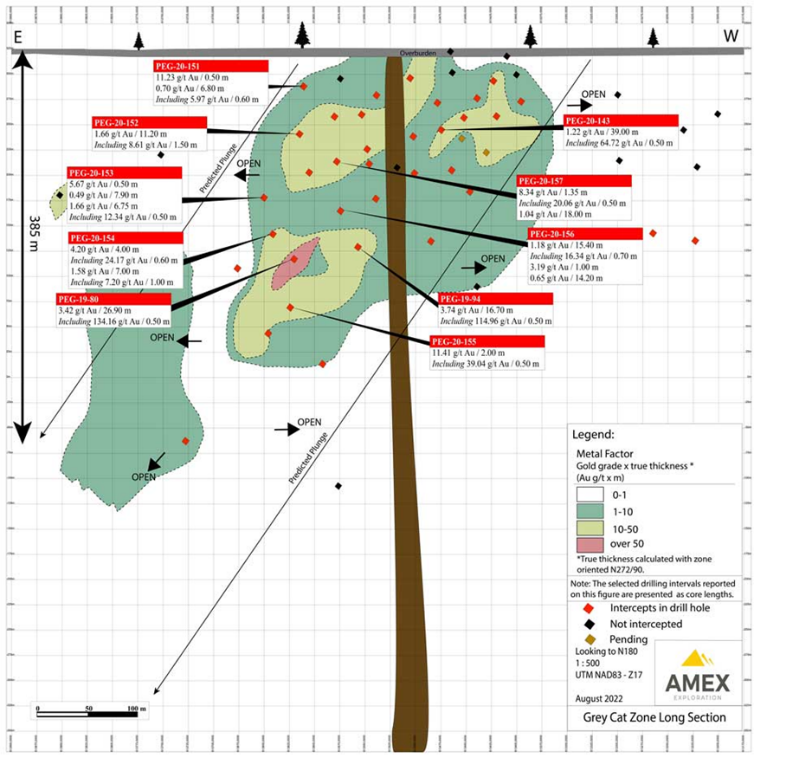 Longitudinal section of the Grey Cat Zone looking to the south. Assay results are presented in core length (m). True width is approximately 50-70% of reported intercepts. Metal factor is defined as gold grade multiplied by estimated true thickness.
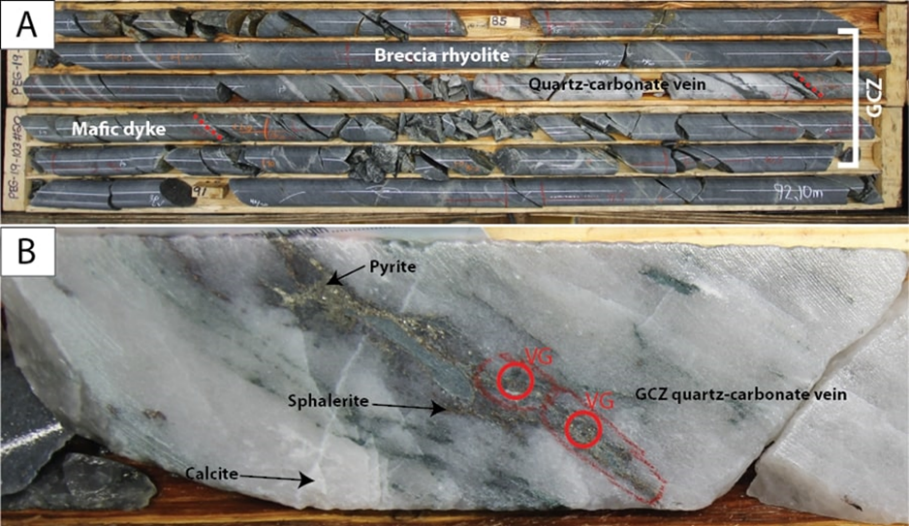 Photos of the GCZ. A) Quartz-carbonate shear vein of the GCZ. B) Visible gold (VG) associated with sphalerite and pyrite.
Consolidated Team Zone
Drilling identified similarities between the Team Zone, 210 and E3 gold zones, therefore making it logical to combine the three. The consolidated gold zones retain the name Team Zone, which creates one larger mineralized corridor straddling the Normétal fault on the northeastern side of the Beaupré Block. The decision is geologically driven as all three zones display remarkable similarity in their lithologies, structures and mineralization style.
The Team zone was discovered in Q4 of 2022 and is a significant component of the overall mineralized system at Perron. It occurs ~600 m to the northeast of the Champagne Zone and ~300 m northeast of the E2 Gold Zone. Mineralization style is defined by centimetric shear to tension gold bearing quartz-sulfides veins/veinlets. Sphalerite, pyrite and traces of chalcopyrite and molybdenite are associated together with a significant amounts of visible native gold grains.
The 210 Gold Zone (210) is located proximal to and south of the northern Normétal fault zone, which is one of two kilometric thrust faults located on the Perron project. The 210 Zone was originally announced as a discovery on February 17, 2021, with hole PE-20-210 returning 58.25 g/t Au over 3.90 m. The identified mineralization is located approximately 650 m north-east of the Champagne Zone in an area that has seen limited exploration. Conveniently, Amex is able to test the near-surface portion of the 210 Zone during deep definition drilling of the Champagne Zone owing to its location. Gold mineralization is hosted within quartz-sulfides veining in sodic rhyolite of the Beaupre Block. Visible gold is observed mainly associated with chalcopyrite, pyrrhotite and sphalerite assemblages.
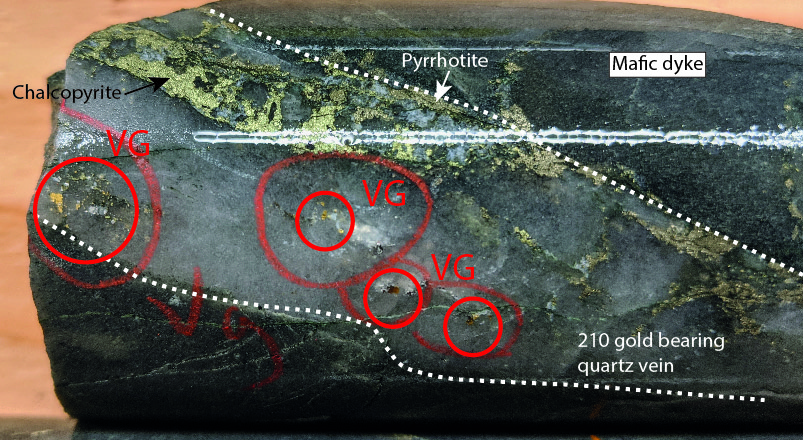 Photo of 210 quartz-sulfides vein associated with visible gold (VG) from hole PE-21-281.
Drill Highlights Include:
Team Zone
- PE-23-680 returned 7.30 m of 4.97 g/t Au, including 0.50 m of 54.12 g/t Au at a vertical depth of ~35 m
- PE-23-702 returned 2.10 m of 23.10 g/t Au, including 0.55 m of 83.98 g/t Au at a vertical depth of ~270 m
210 Gold Zone (now part of Team Zone)
- PE-20-229 returned 1.12 g/t Au over 19.50 m at a vertical depth of ~90 m
- PE-21-280 returned 2.39 g/t Au over 9.00 m at a vertical depth of ~90 m
- PE-21-301 returned 0.82 g/t Au over 15.00 m at a vertical depth of ~70 m
- PE-22-586 returned 11.50 m of 4.57 g/t Au, including 3.00 m of 10.72 g/t Au at a vertical depth of ~115 m
- PE-23-639 returned 19.10 m of 3.23 g/t Au, including 1.40 m of 29.76 g/t Au at a vertical depth of ~190 m
Note: The drill intervals for the Team and 210 zones are presented in core lengths, as its estimated true width is currently unknown.
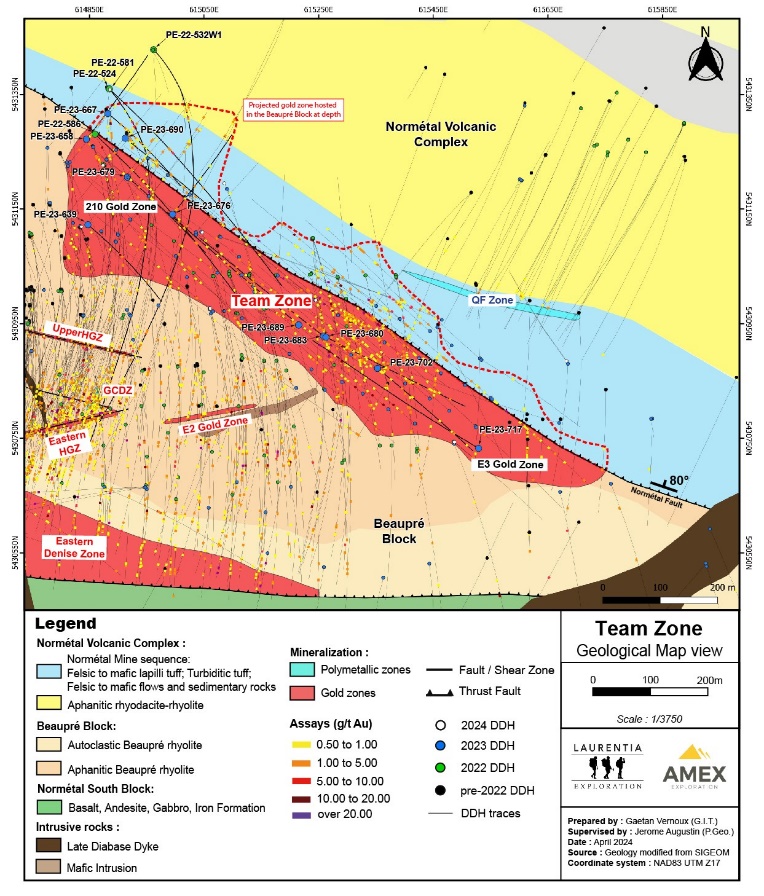 Image showing the modelled wireframes of the 210 Zone, the Team Zone and the E3 Zone, displaying the similarities of mineralization orientations.
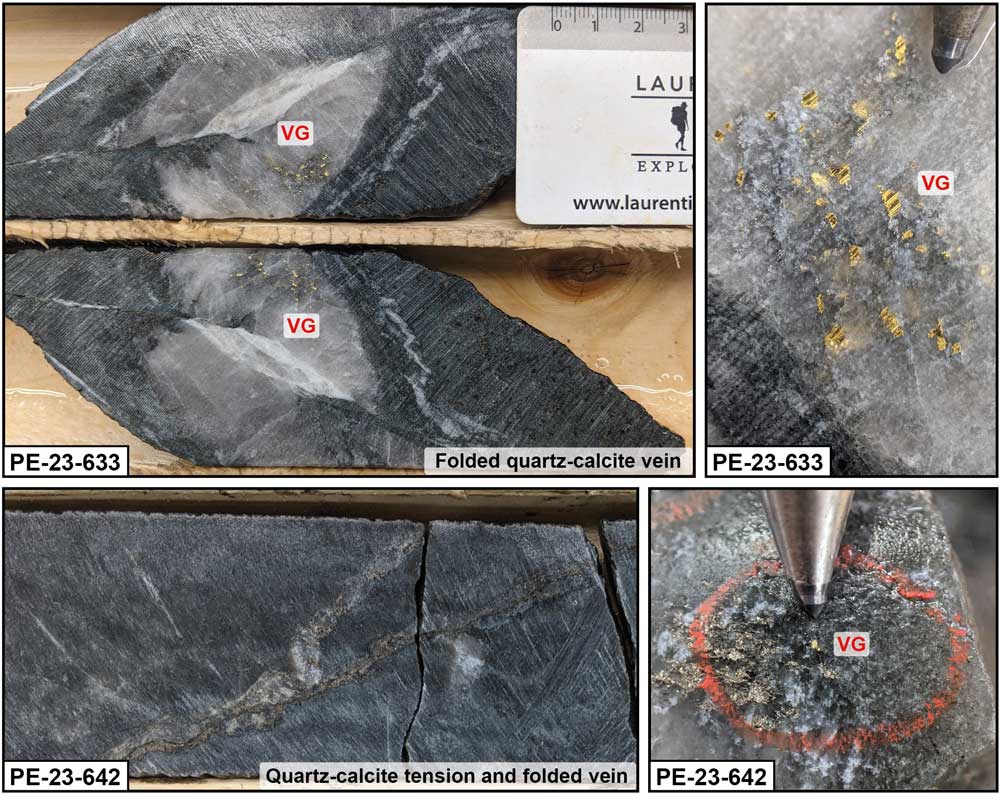 Highlight photos of the Team Zone in drillholes PE-23-639, PE-23-680, PE-23-702 and PE-23-717. Gold mineralization is associated with tension style quartz-sulphide veins and contains visible gold. Abbreviation: VG - Visible Gold.
JT Gold Zone (JT)
The new gold discovery in a never-before-seen lithology within the Beaupré Block of the Perron project in the Abitibi region of Quebec, was found within a felsic to intermediate dike with various levels of sulfide mineralization containing gold grades. The JT Zone is located approximately 750 m to the north-northwest of the Champagne Zone and approximately 600 m to northwest of the Team Zone. The JT dike is oriented WNW-ESE with a strike length to date of 275 m, plunging to the east, and a thickness of 60 m. The mineralized dike remains open to both the west and the east, as well as at depth.
The felsic to intermediate dike that defines the JT Zone contains varying levels of sulfide mineralization, being mainly pyrrhotite and pyrite with occasional traces of sphalerite. Mineralogy of the dike consists of feldspar, quartz, amphibole, chlorite and biotite. Studies will be completed to better understand the relationship between the percentage of sulfide mineralization and gold grades.
In addition, the JT Zone also comprises gold bearing quartz-carbonate veins that are hosted in the aphanitic rhyolite of the Beaupré Block, highlighting the zone's potential for multiple styles of mineralization.
Drill Highlights Include:
- PEX-24-222 returned 70.50 m of 0.91 g/t Au, including 10.50 m of 2.83 g/t Au at a vertical depth of ~20 to 70 m in the JT Zone
- PEX-24-213 returned 49.50 m of 0.86 g/t Au, including 5.90 m of 2.39 g/t Au at a vertical depth of ~210 to 250 m in the JT Zone
E2 Gold Zone (E2)
The E2 Gold zone represents one of the most significant new discoveries on the Perron Project since the discovery of the Champagne Zone in 2018. The E2 zone was discovered by stepping out to the East along the same structure that hosts the bonanza mineralization of the Champagne Zone.
Mineralization identified to date is very similar to the Champagne Zone, with a repetition of a mineralized hanging wall vein, a largely unmineralized narrow mafic sill, and a mineralized footwall vein. Sulfide minerals are also very similar, with sphalerite being the most common sulfide associated with gold mineralization, along with lesser pyrite. Visible gold has been identified in several drill holes. Of particular importance is the projected plunge of the mineralization. The E2 has now been expanded down to a vertical depth of 370 m and along strike for 325 m.
Highlights from E2 Gold Zone include:
- PEX-20-034 returned 5.58 g/t Au over 13.85 m including 136.02 g/t Au over 0.55 m at a vertical depth of ~100 m
- PEX-21-066 returned 4.54 g/t Au over 8.45 m at a vertical depth of ~170 m
- PEX-22-102W1 returned 3.71 g/t Au over 10.10 m including 33.62 g/t Au over 0.50 m at a vertical depth of ~320 m
Note: The drill intervals for the E2 are presented in core lengths, as its estimated true width is currently unknown.
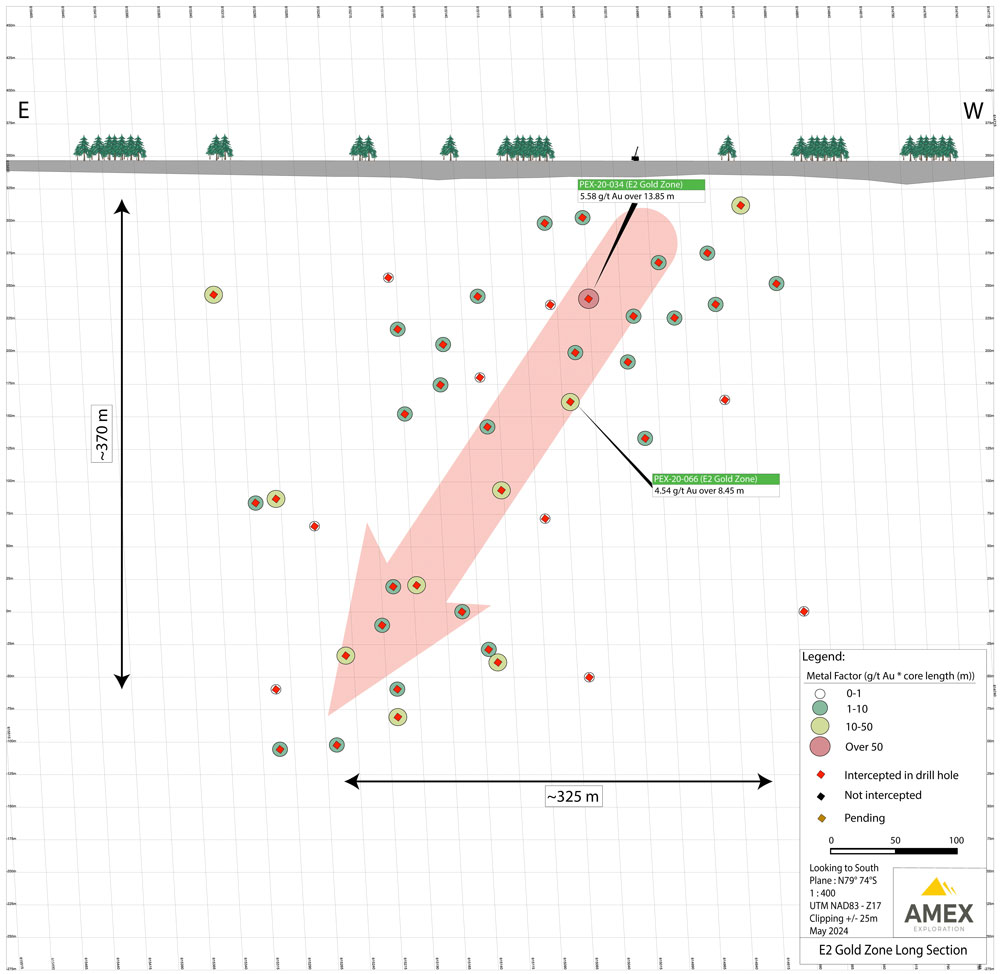 Longitudinal section of the E2 Gold Zone looking to the south. Assay results are presented in core length (m). Metal factor is defined as gold grade multiplied by core length. Note: The drill intervals above are presented in core lengths, as the estimated true width is currently unknown.
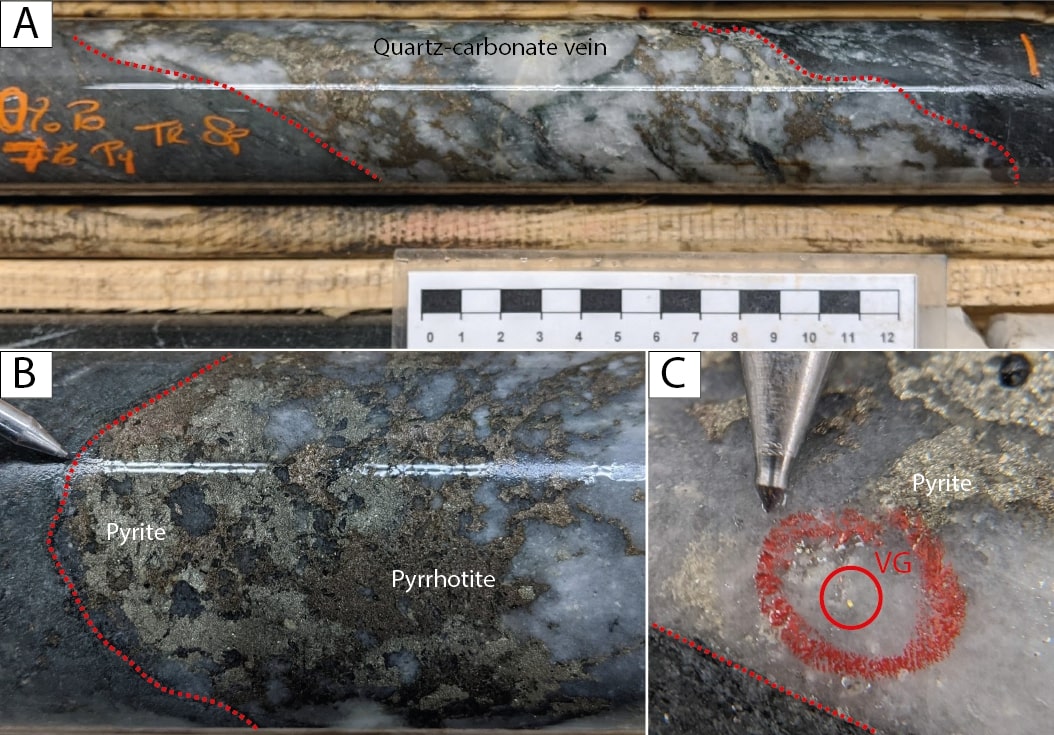
Photos of the E2 Gold Zone.
A) Gold bearing quartz-carbonate-sulfides shear vein.
B) Sulfides assemblage defined by pyrite and pyrrhotite in gold bearing quartz-carbonate vein.
C) Example of visible gold in the quartz-carbonate vein.
Upper Champagne Zone (UCZ)
The Upper Champagne Zone is situated approximately 200 m North of the Champagne Zone. Of interest is its orientation, which trends to the West-Northwest, at an angle of approximately 30 degrees away from the orientation of the Champagne Zone. The Upper Champagne Zone is often hosted by or proximal to a swarm of narrow mafic sills/dikes, and mineralization is associated with quartz veining, pyrrhotite, pyrite, sphalerite, and visible gold mineralization. Owing to its location and proximity to the Champagne Zone, Amex is able to continue testing it through its definition and expansion drilling program on the Champagne Zone.
Highlights from Upper Champagne Zone include:
- PE-20-207W1 returned 18.79 g/t Au over 1.05 m at a vertical depth of ~600 m
- PE-20-190 returned 1.01 g/t Au over 17.20 m at a vertical depth of ~600 m
- PE-20-186A returned 4.08 g/t Au over 3.50 m at a vertical depth of ~90 m
Note: The drill intervals for the Upper Champagne Zone are presented in core lengths, as its estimated true width is currently unknown
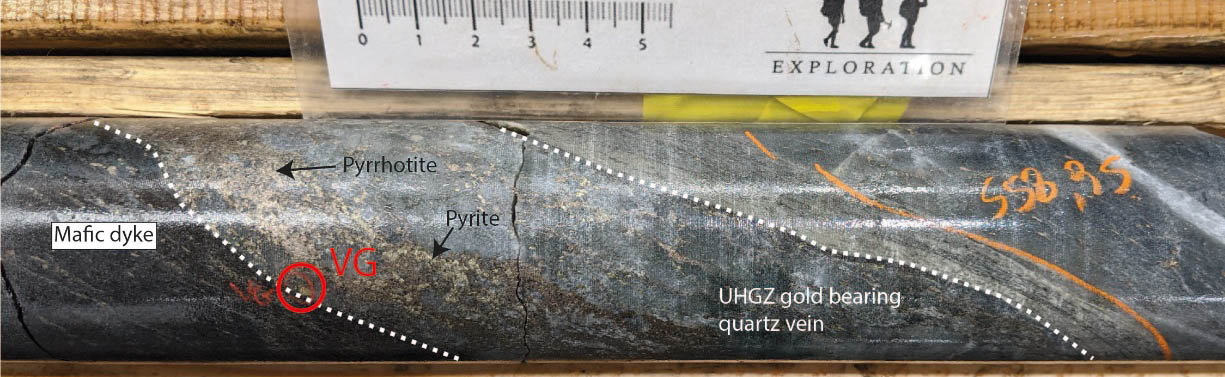
Gold bearing quartz-sulfides shear vein of the Upper Champagne Zone
QF Zone
A copper rich volcanogenic massive sulfide (VMS) discovery (QF Zone) was made along the Normétal Mine Horizon where the company intersected 2.40% Cu, 0.72% Zn, 0.27 g/t Au and 22.15 g/t Ag over 7.80 m in hole PEX-21-076. The Normétal Mine Horizon is prolific for Zn-Cu VMS system and hosted historical Normétal Mine and Normetmar satellite.
Follow up drilling in 2022 confirmed the initial discovery with similar grades and widths, indicating the presence of a substantial VMS system. PEX-21-083, which is approximately 65 m deeper than the discovery hole, returned 1.93% Cu, 0.15% Zn, 0.28 g/t Au, and 14.0 g/t Ag over 8.0 m, including a high-grade core of 3.40% Cu, 0.25% Zn, 0.48 g/t Au, and 24.31 g/t Ag over 4.55 m, which confirms both the width and grade of the discovery hole.
Highlights from 2023 drill program on QF Zone include:
- PEX-22-131 intersected 2.29% CuEq comprising 1.53% Cu, 1.33% Zn, 0.20 g/t Au and 12.65 g/t Ag over 9.85 m (core length) including 4.88% CuEq comprising 3.98% Cu, 0.90% Zn, 0.50 g/t Au and 27.27 g/t Ag over 2.55 m (core length) at a vertical depth of approximately 700 m
- PEX-22-128 intersected 2.43% CuEq comprising 1.89% Cu, 0.35% Zn, 0.42 g/t Au and 15.64 g/t Ag over 5.15 m (core length), including 5.18% CuEq comprising 3.55% Cu, 2.67% Zn, 0.60 g/t Au and 22.25 g/t Ag over 3.55 m (core length) at a vertical depth of approximately 500 m
A metallurgical hole drilled in 2024 down dip in the QF Zone reported 3.43% Copper, 34.00 g/t Silver, 1.80% Zinc and 0.30 g/t Gold over 20.80 m.
Note: The drill intervals for the QF Zone are presented in core lengths.
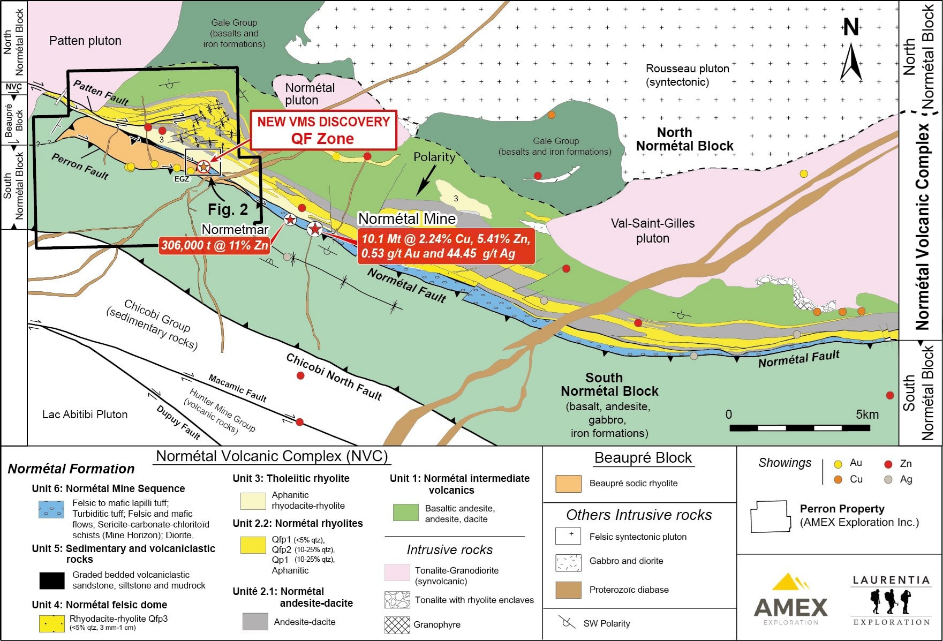
Geological map of the Normétal Volcanic Complex, with the location of the Perron Property and the new QF Zone discovery.
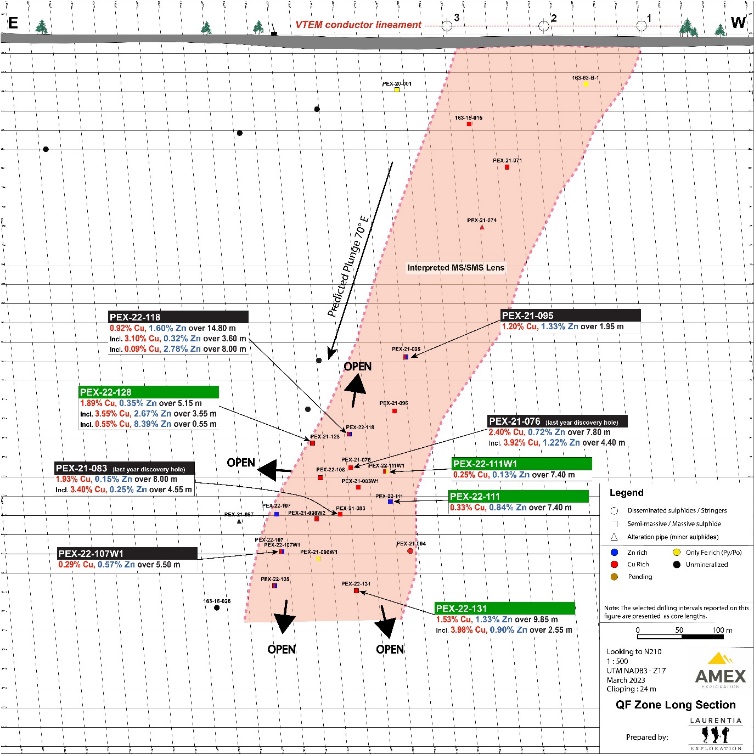
Long section of QF Zone looking to the south. Assay results are presented in core length (m). True width is approximately 65-85% of reported intercepts.
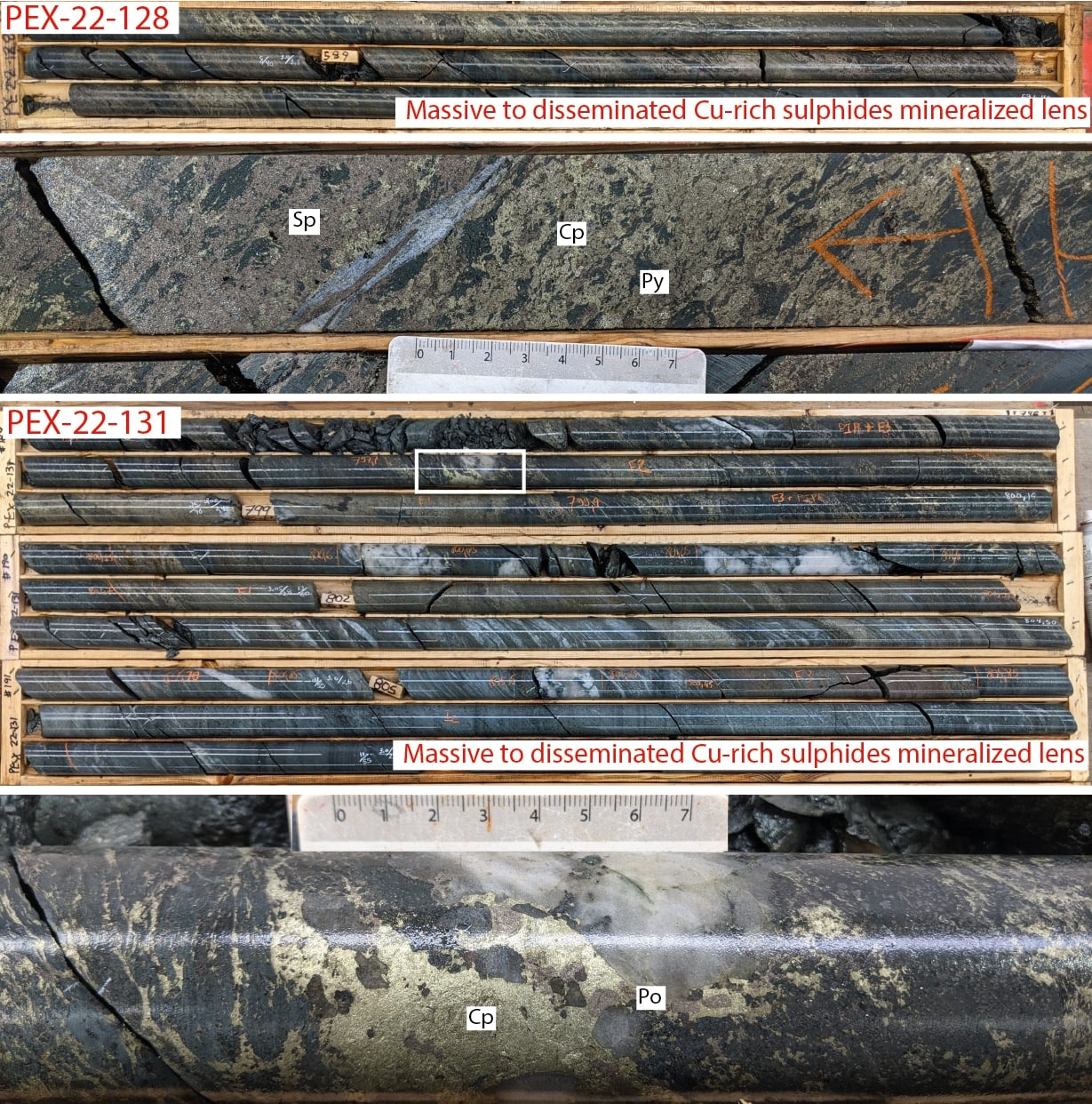
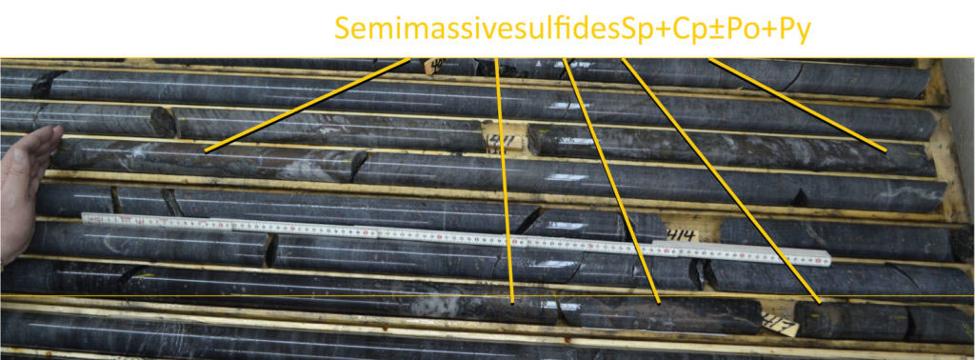
Photos of the massive to disseminated sulphide Cu-rich lens intersected in drillholes PEX-22-128 and PEX-22-131. Abbreviations: Cp - Chalcopyrite, Sp - Sphalerite, Po - Pyrrhotite, Py – Pyrite.
Donna Gold/Copper Zone (Donna)
The Gold/Copper Donna Zone discovery occurs immediately north of the CZ at depth. It was discovered during deep expansion drilling of the CZ. The mineralization identified, which is similar in each of the three holes reported, consists of highly chlorite-garnet-amphibole altered rhyolite which hosts centimetre-scale stringers of chalcopyrite-pyrrhotite. The correlation between gold and copper is quite strong. Amex has completed a borehole electromagnetic survey on this new discovery and is planning follow-up drilling.
Highlights from gold-copper Donna Zone include:
- PE-21-318W1 returned 1.37 g/t Au and 0.25 % Cu over 56.00 m including 3.59 g/t Au and 0.72 % Cu over 14.70 m at a vertical depth of ~1000 m
- PE-21-318 returned 0.79 g/t Au and 0.24 % Cu over 29.15 m at a vertical depth of ~1020 m
- PE-21-318W2 returned 0.89 g/t Au and 0.20% Cu over 16.00 m at a vertical depth of ~1050 m
Note: The drill intervals for the Donna zone are presented in core lengths, as its estimated true width is currently unknown.
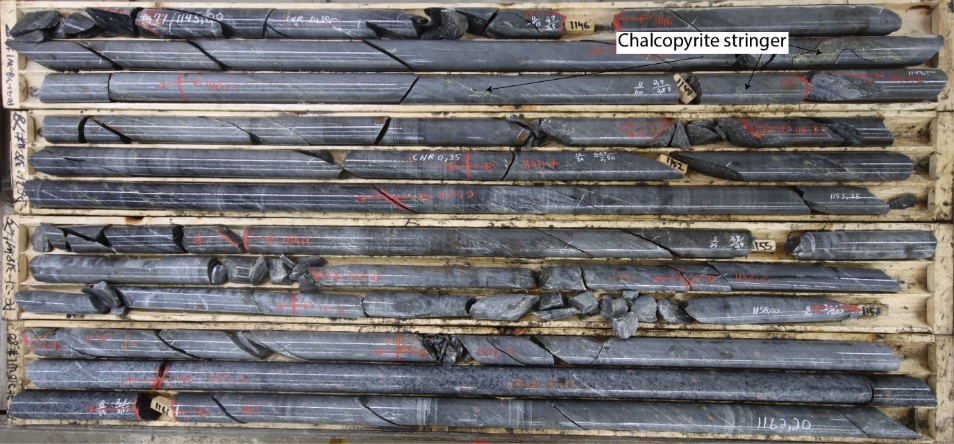
Photo of Donna Gold-copper mineralization-style with several stringer hosted in aphanitic rhyolite.
Central Polymetallic Zone
In March 2013, Amex made a significant discovery of a high-grade gold-rich polymetallic intercept from 402.00 to 417.20 m of 3.84 g/t Au, 23 g/t Ag, 1.4% Zn, 0.10% Cu over 15.20 m (Including 19.07 g/t Au, 102 g/t Ag, 5.0% Zn, 0.38% Cu, 0.13% Pb over 2.00 m from 410.50 to 412.50 m) in hole PE2013-03.
Note: The drill intervals for the Central Polymetallic zone are presented in core lengths.
Qualified Persons, Quality Assurance & Quality Control
Jérôme Augustin P.Geo. Ph.D., (OGQ 2134), Independent Qualified Persons as defined by Canadian NI 43-101 standards, have reviewed and approved the geological information reported. The drilling campaign and the quality control program have been planned and supervised by Jérôme Augustin. Core logging and sampling were completed by Laurentia Exploration.
The quality assurance and quality control protocols include insertion of blank or standard samples every 10 samples on average, in addition to the regular insertion of blank, duplicate, and standard samples accredited by Laboratoire Expert or ALS Canada Ltd. during the analytical process.
For all analyses targeting gold mineralization, gold values are estimated by fire assay with finish by atomic absorption. Values over 3 ppm Au are reanalyzed by fire assay with finish by gravimetry by Laboratoire Expert Inc, Rouyn-Noranda. Samples containing visible gold mineralization are analyzed by metallic sieve. For additional quality assurance and quality control, all samples were crushed to 90% less than 2 mm prior to pulverization, in order to homogenize samples which may contain coarse gold.
For analyses targeting VMS mineralization, zinc, copper and silver values are estimated by four acid digestion multi-elements Inductively Coupled Plasma - Atomic Emission Spectroscopy (ICP-AES), ME-ICP61 at ALS Canada Ltd. Zinc values over 1%, copper values over 1%, and silver values over 100 g/t are estimated by four acid digestion ICP-AES, OG62. Gold values are estimated by fire assay with atomic absorption finish.